Free & open source · Windows 64-bit

Game Capture for VDO.Ninja

Stream games, app windows, webcams, or Spout2 avatars from Windows to VDO.Ninja and OBS. Share a viewer link, join a production room, or send transparent video to the OBS native receiver.

Release notes and all downloads: View the latest release

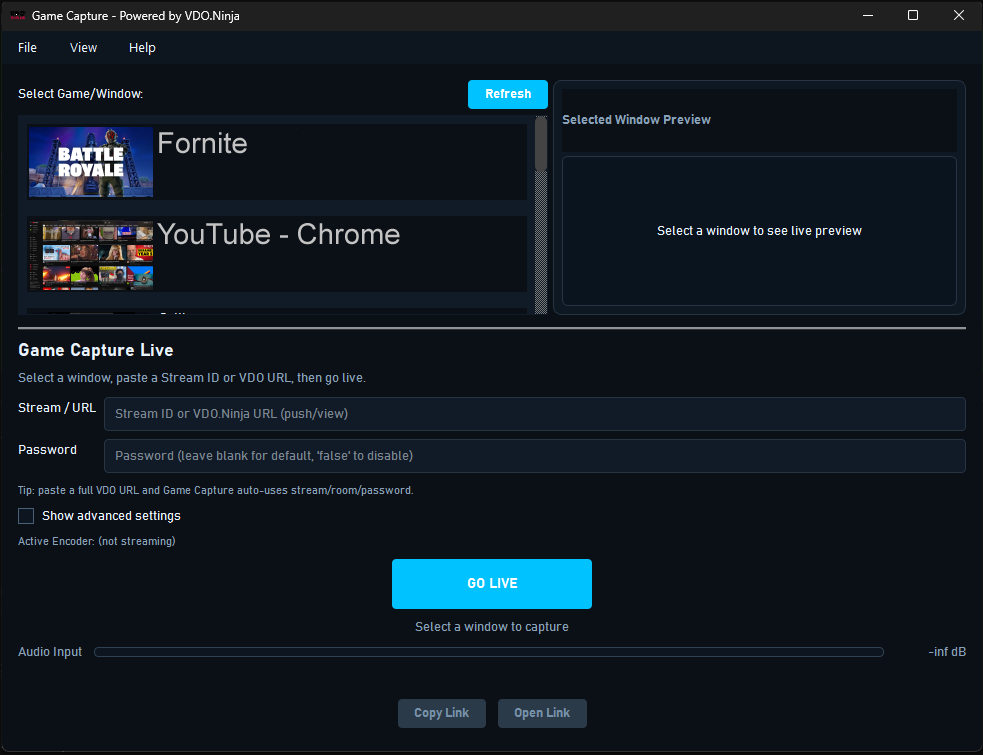
Game Capture app window showing window selection and go live controls
Game Capture: choose a source, set your stream details, and go live.

Quick Start

  1. Download and open Game Capture on Windows.
  2. Select a game window, webcam, or Spout2 sender, then choose audio if needed.
  3. Enter a stream ID or paste a VDO.Ninja link, then click Go Live.
  4. Open the generated viewer link in a browser or OBS. For transparency, follow the alpha setup below.

Why This App

  • Window audio capture without virtual audio cables.
  • Hardware-accelerated encoding for smoother performance.
  • Dual-stream quality model: HQ + LQ routing when needed.
  • Multiple viewers from one HD encode workflow.
  • Native Qt app without an Electron runtime.
  • Simple alternative to OBS for guest-side game feed publishing.
  • Optional camera/webcam publishing with a selectable microphone and local publisher preview.
  • Direct Spout2 input for VTuber avatars and transparent graphics.
  • Built for VDO.Ninja compatibility and link workflows.

Spout2 & VTuber Sources

  • Receive local Spout2 video from VTube Studio, Warudo, VSeeFace, VNyan, and similar Windows apps.
  • Enable Spout output in the avatar app, choose Spout2 (avatar apps), and select its sender.
  • Spout2 carries video only; choose an output mix or microphone separately if the feed needs audio.
  • Use VP9 with the OBS alpha workflow for true transparency, or chroma background with H.264/NVENC.
  • If the sender is black, set Game Capture and the sender app to the same GPU in Windows Graphics settings.

Open the Game Capture and Spout2 setup guide.

Transparency in OBS

  • Use VP9 (OBS Alpha Preview) with alpha enabled for transparent OBS playback.
  • VP9 alpha requires the bundled LGPL FFmpeg/libvpx VP9 encoder and is CPU-encoded.
  • Transparent OBS playback requires the VDO.Ninja OBS plugin with Use Native Receiver (Experimental) enabled.
  • OBS Browser Sources and normal browser viewers receive standard color video instead of composited transparency.
  • Compatible OBS VDO.Ninja native receivers upgrade that stream to transparency automatically.
  • For hardware encoding, use Alpha Background → Chroma background and key the selected color in the receiver.
  • VP9 alpha is CPU-heavy; try 1080p30 or 720p60 first if 1080p60 drops frames.
  • Leave alpha off when you want the widest viewer compatibility.

Compatibility & Performance

  • Windows only right now.
  • The OBS plugin v1.1.68 native receiver accepts H.264 and VP9; HEVC/AV1 are not supported by that receiver.
  • Explicit NVENC/QSV can fall below 30 FPS at 4K. Lower resolution or frame rate if playback falls behind.
  • Room roles are not an access-control boundary; share production links with trusted participants.
  • Limit max connections to protect publisher performance.
  • Public roadmap and test plans live in the GitHub repo.

Frequently Asked Questions

Do I need OBS on the sending computer?

No. Game Capture publishes directly to VDO.Ninja. A remote producer can receive the stream in OBS, while ordinary viewers can use a browser.

Will a transparent Spout2 feed work in an OBS Browser Source?

Browser Sources show the color video, without compositing the alpha track. For true transparency, use VP9 alpha and the VDO.Ninja OBS plugin's native receiver. Alternatively, select a chroma background and add a chroma-key filter in OBS.

Why does my Spout2 feed have no sound?

Spout2 carries video only. Choose a microphone or output mix separately in Game Capture when you need audio.

Can I automate Game Capture with an AI assistant?

Yes. The local API and optional MCP bridge provide source discovery, stream launch, status, logs, and recovery controls. See the AI and automation guide for setup.

Where can I get setup help or report a problem?

Start with the setup guide or README. For a reproducible problem, open a GitHub issue with your source, encoder, receiver, and logs from Help → Open Log Folder.